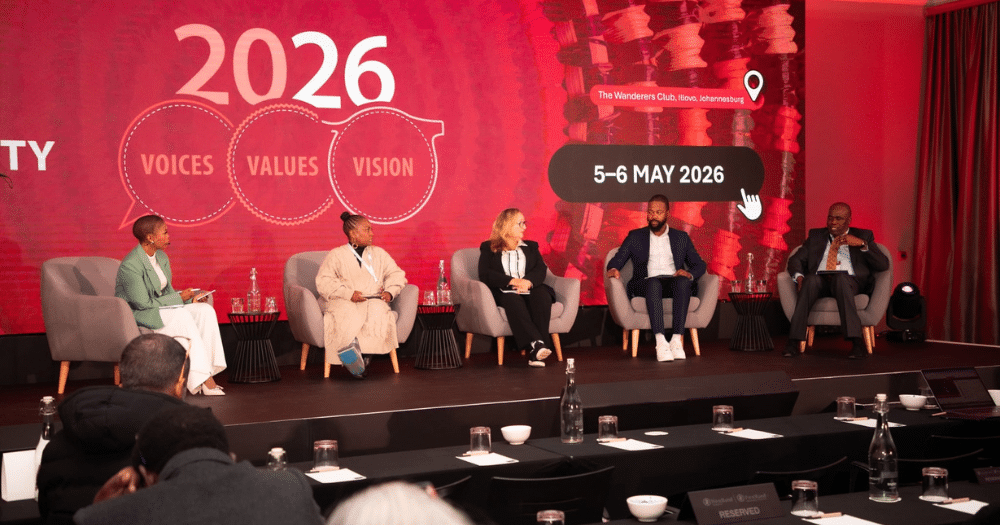
A powerful afternoon session on the second day of the 2026 Trialogue Business in Society Conference brought companies and nonprofits into frank conversation about what it really takes to fund impact – from partnership strategies and fundraising realities to the challenge of creating genuine shared value.
Titled ‘Funding for impact: A new playbook for partnerships’, the session featured representatives from five of the conference’s content sponsors: the FirstRand Foundation, the Development Bank of Southern Africa, MTN, Absa and Edu Invest powered by Wesgro. Citizen Leader Lab, Footprints Foundation and The Feenix Trust represented nonprofits.
The interactive discussion, moderated by Trialogue’s thought leadership manager, Sheldon Morais, was divided into three distinct panel sessions.
Session 1
Closing the gap between funding and impact
For Mandla Mbuyazi, Impact Investment and Ideation Lead at the FirstRand Empowerment Foundation, partnerships that fail do so not for lack of funding, but because of a mismatch between capital and reality. “We fund, design and measure from a distance, but impact doesn’t happen at a distance. We need to design with proximity to reality,” he pointed out.
He went on to argue that capital is far from neutral as it “influences and directs” – and that catalytic capital should not carry all the risk. “Too many of our models are built on risk transfer and not risk sharing. That’s a problem! Funders transfer risk to implementers, and communities carry the outcomes, but we call this partnership,” Mbuyazi noted.
This is prompting a shift in how FirstRand approaches partnerships, with a deliberate move away from trying to “be all things” towards fewer, deeper relationships focused on what capital actually delivers. Trust, track record, community relationships and long-term potential are prioritised, often through co-creation with partners over time. Mbuyazi pointed to the development of Africa’s first Nature-linked Outcomes-based Bond as an example of this complexity, a process that involved multiple funders and took 18 months to structure.
Ultimately, he stressed that collaboration and trust are not “soft concepts” but “part of the capital strategy”, and that a true test of a partnership’s effectiveness is whether the system continues when the funding ends.
Wendy Viljoen, Senior Manager of Edu Invest at Wesgro, noted that education is not just a social concern but an economic imperative. A catalytic project established within Wesgro two-and-a-half years ago, in partnership with the Western Cape Education Department, Edu Invest was created to drive and unlock private-sector investment in education in the Western Cape.
Effective partnerships require flexibility, alignment and long-term engagement rather than a fixed funding model. “There’s no one-size-fits-all approach,” Viljoen explained. “We walk a mile with the companies we work with. We may not find something to collaborate on immediately, but we’re building so we can work together for a longer-term goal.”
Partnerships are built over time and depend on understanding what each corporate partner wants to achieve, then shaping opportunities around it. The goal is to mobilise funding into coordinated, long-term interventions with defined outcomes, rather than isolated projects.
Crucially, Viljoen stressed that these partnerships must be grounded in the realities of the communities they aim to serve. “We make sure we have proper community engagement – we start there,” she said, adding that beneficiaries must be at the centre of decision-making. This includes involving community leaders in shaping interventions and ensuring that implementation partners are closely connected to the areas they serve.
This dual focus – on strategic alignment at the top and community insight at the grassroots – allows Edu Invest to connect long-term funding commitments with locally relevant, needs-driven solutions across the education value chain.
Komala Pillay, CEO at Citizen Leader Lab, highlighted the practical realities of sustaining partnerships over time.
With nearly 200 corporate funders over 16 years, the nonprofit pairs public school principals with corporate executives to build active citizenship, address systemic inequalities, and strengthen communities. Some partnerships are short-term and transactional, while deeper ones are built on mutual trust and require sustained effort to create and maintain.
Pillay emphasised mutual value creation as the foundation of strong partnerships. “You can serve the community and also create value for your funding partner,” she said, urging nonprofits to add value through professionalism and good governance – including helping companies meet their scorecard requirements and enabling meaningful community engagement.
At the same time, she pointed to a growing tension between corporate timelines and the realities of social impact. Drawing on her own business background, she acknowledged the importance of performance cycles. Still, she argued that “we need to help business to speak social development” – and that this learning happens through partnership.
Crucially, she reframed partnerships as multi-directional, value-sharing relationships. “Partners are two or more entities all bringing value that’s recognised,” she said, noting that nonprofits, funders and communities each contribute distinct insights. Because nonprofits are closest to the ground, they also help funders adapt their expectations and approaches over time. “We motivate for 10- or 15-year plans as a sector,” she added, calling for longer-term horizons to achieve meaningful change.
On the corporate side, Pillay urged companies to help nonprofits manage their time more effectively by communicating more clearly. “Understand why you fund, where you fund, how much you want to invest, and what your internal processes and timelines are,” she said.
She also stressed the importance of feedback in strengthening the sector. “We need to know when we’re going to hear a yes or no… If it’s a no, tell us, and give us feedback. We’re here to learn and grow. If we’re not learning from each other, we’re not growing.”
Across the discussion, a consistent theme emerged: effective partnerships require more than aligned strategies or increased funding. They demand a fundamental rethink of how capital is structured, how risk is shared, and how closely funding is connected to the realities on the ground.
A poll conducted at this point in the session indicated that delegates feel corporate-nonprofit partnerships deliver inconsistently, suggesting there is clear room for improvement.

Session 2
Reimagining funding to back ideas and build ecosystems
The next part of the discussion focused on how funders are rethinking their models, moving beyond traditional grant-making towards more flexible, inclusive and ecosystem-driven approaches.
Lunga Schoeman, Corporate Social Investment Programmes Lead at the Development Bank of Southern Africa (DBSA), described a deliberate shift from grant-making to creating a “developmental impact platform”. This has meant backing unconventional ideas and partners, and rethinking how proposals are assessed.
“We fund the strength of the idea, not the proposal,” he said, explaining that DBSA looks for potential to scale and drive systems change. To broaden access, organisations can submit proposals in any language – or even via voice notes – recognising that many grassroots organisations lack access to formal proposal-writing tools.
Schoeman stressed the importance of allowing organisations to tell their own stories and of moving beyond paper-based assessments. “Only so much you can visualise from reading. Go into the community to understand why this particular person is doing that particular work,” he said.
Central to the new approach is a focus on partnerships that can unlock wider impact. A good example is DBSA’s partnership with Breadline Africa to eliminate unsafe pit toilets in schools in KwaZulu-Natal and the Eastern Cape.
For Schoeman, fairness is critical – particularly in how nonprofits are supported and paid. This includes covering costs often excluded from budgets and allowing organisations flexibility in how funds are used. The goal is not only to maximise impact, but to ensure the sustainability of the organisations delivering it.
From the nonprofit perspective, Eric Mlambo, CEO and founder of Footprints Foundation, highlighted both the opportunity and the tension within these evolving models. While co-creation can unlock innovation, it often requires negotiation with funders used to controlling programmes. In one case, a partnership designed to expand reach across multiple corporates took two-and-a-half years to structure because the company wanted to “own the name of the programme”.
Mlambo argued that nonprofits are a key source of innovation. “Innovation comes from us as the NPOs,” he said, noting that organisations are often best placed to identify and respond to real gaps in communities.
He cited the example of Walk Her Story, a national campaign with FootGolf South Africa aimed at shifting GBV survivors from “victims” to “witnesses” with agency. By sharing survivor-led stories, the initiative opens pathways for company support that are rooted in lived experience rather than predefined strategies. “We need to open spaces for companies with ideas not sitting in their strategic plans but rooted in communities,” he said.
Mlambo also challenged funders to recognise the full cost of delivery – including the human cost. “If 90% goes to beneficiaries and 10% to delivery, you’re excluding the human factor,” he said, pointing to the financial and emotional strain placed on nonprofit leaders. “You claim the impact as yours, but you’ve neglected delivery.” Rather than extracting value, he argued, funders should actively strengthen their partners – for example, by supporting core costs and organisational capacity.
Zintle Raziya, Senior Programme Manager at Absa Group, emphasised that partnerships are evolving from transactional engagements to more deliberate, co-creative relationships grounded in shared outcomes. This requires not only alignment on strategy, but also earlier integration of monitoring and evaluation (M&E).
“How do we bring the M&E team in at the start of the journey?” she asked, noting that impact measurement should be embedded from the outset rather than treated as an afterthought. Working with partners at different stages of maturity, Absa integrates M&E support early, helping to clarify goals, build appropriate frameworks and align expectations.
This includes pre-site visits before proposals are tabled, ongoing engagement through quarterly reviews, and continuous feedback loops. Listening to partners at a grassroots level is critical, she said, both for adaptive management and for keeping interventions relevant.
Raziya also pointed to a shift towards measuring outcomes rather than just activities, with co-creation helping to “shift the dial” in how impact is defined and delivered. At the same time, she emphasised the need to balance accountability with support – providing partners with templates, tools and capacity-building where needed, while allowing more advanced organisations greater flexibility.
She acknowledged a key friction point in the system: the limitations of short-term funding. “Single-year funding doesn’t work,” she said, noting that Absa is exploring multi-year approaches in response to partner feedback, while maintaining accountability for results.
Session 3
Balancing purpose, partnership and practical realities
The final part of the session turned to the realities of delivering impact in complex, resource-constrained environments.
Lesimola Selepe, Senior Manager for Education, Youth and Women’s Programmes at MTN, positioned CSI as inseparable from business strategy. As a profitable company operating in an unequal society, MTN has a responsibility to contribute to development.
“You can’t divorce yourself as a business from what’s happening within society,” he said, noting that the long-term sustainability of the business is tied to the wellbeing of its communities. Intentional funding decisions and strong monitoring and evaluation inform MTN’s work – but Selepe stressed the complexity of working in under-resourced contexts, where immediate needs often sit alongside longer-term goals.
This tension plays out in practice. While MTN focuses on digital skills and access, programmes often encounter more basic constraints. In one case, a training initiative overlooked catering. For Selepe, this highlights the need to address immediate barriers. Selepe called for more open, transparent and feedback-driven collaboration to avoid such missteps in future.
From the nonprofit perspective, Cara-Jean Petersen, CEO of The Feenix Trust, emphasised that strong partnerships begin with honest storytelling. “How do you tell the real, authentic story of what you do while still showing the need?” she asked.
She reflected on Feenix’s fundraising journey, noting that the organisation secured R48 million in 2022, only to see it drop to R14 million in 2023. “The world had changed,” she explained. “So many corporate partners were undergoing a CSI refresh and pausing their funding – and internally, we had a 45% staff turnover within 18 months.”
She said only the team’s sheer determination, commitment to the organisational ‘why’, and personal values allowed it to prevail – along with trust in fundraising best practice. Feenix experienced 580% income growth and last year secured more than R95 million for students, “thanks to our amazing corporate partners who chose to co-create with us”.
This required a mindset shift. “Donors owe you nothing,” Petersen said, stressing the need to understand funders’ priorities and position nonprofits as strategic partners rather than beneficiaries – demonstrating clear value, strong governance and measurable impact.
She also cautioned against treating fundraising and programme delivery as separate functions. “Both perspectives matter,” she said, describing how Feenix brought teams together to reflect both student needs and donor expectations better.
Data has been central to navigating short-term pressures and long-term goals. Regular student surveys surfaced issues, including mental health, as early as 2020, enabling proactive engagement with funders – balancing immediate support (“quick fixes”) with longer-term investment.
Importantly, Petersen highlighted the role of funders in creating space for honest feedback. Partnership forums, one-on-one engagements and anonymous surveys have helped reduce fear and address power imbalances. “The message from our partners has been: your voice matters – and we are willing to co-create with you,” Petersen said.
Session takeaways
A final poll revealed that delegates considered short funding cycles to be the biggest barrier to achieving lasting impact.

Lessons from the three lively sessions include:
- Impact doesn’t fail because there’s no money – it fails when funding doesn’t match what’s happening on the ground.
- Partnerships work better when everyone shares the risk, instead of pushing it onto nonprofits and communities.
- Funders should look at the strength of an idea and its potential, not just how polished the proposal is.
- Real impact takes time, so funding over a longer term is preferred.
- Nonprofits bring valuable insight and innovation because they are closest to the problem.
- Funding must cover the real cost of doing the work – including people, time and running an organisation.