Among the many challenges facing South Africa’s blind population, earning a living is one of their greatest hurdles. With an overwhelming 97.7% of blind individuals in the country unable to find employment, it seems a great deal more needs to be done to include people with disabilities in economic activity.
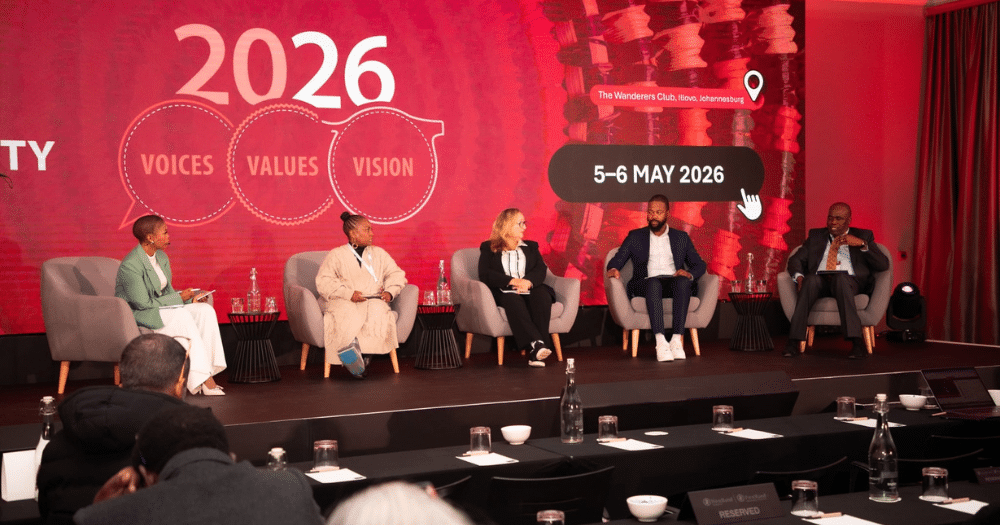
Presenting his inspirational story at the Trialogue Business in Society Conference 2026, Hein Wagner, an advocate for the visually impaired and motivational speaker, told his story of turning the ‘blind-from-birth’ cautionary label on his CV into a route to economic inclusion for other blind South Africans.
Wagner was born with a condition called Leber’s Congenital Amaurosis, though he has never allowed it to define the boundaries of his life. He has run the Antarctica Marathon, sailed the Cape to Rio Yacht Race, set the blind land-speed record twice, and completed the Ironman Challenge. His presentation was less about those feats, however, and more about the principles he credits with generating “more light into my life than sight can ever begin to do.”
Relating his childhood memories of being sent to the Pioneer School for the Blind in Worcester at age five and being rejected by his sighted friends on account of his disability on his first weekend home, Wagner resolved to reintegrate into his neighbourhood peer group by learning to do what they were doing – ride a bicycle. Two hours of frustrated attempts later, he was about to give up when something made him take four more steps. And within those steps, he discovered he could use the sound of the bicycle chain reflecting off the pavement to cycle in a straight line. Perseverance and the novel application of his other senses allowed him to overcome his exclusion.
Years later, sitting in a physiology class at the school for the blind, Wagner discovered that only one in 80 000 children is born with his condition. He realised he had a choice, he said: “I could either see this as the most negative thing that I’ve ever discovered, or I could own it, embrace it with everything I have in my being.” The second option was, by his own account, the single most difficult decision he has made in his life. But it was also the one that changed everything.
The decision to unconditionally accept his blindness has been his greatest achievement, more significant than any physical record or adventure. “It moved me from being blind to being blinded by possibility,” he told the audience.
Years later, at a visit to a school on the edge of one of Mumbai’s largest slums, where forty deaf-blind children were being educated, Wagner met a teacher who had been at the school since the age of eight, gone on to earn a master’s degree in education and was now teaching others like him. They communicated by swapping hands on a keyboard and reading a real-time braille display. When Wagner asked how the teacher had managed to achieve what he had, the reply came back: “A deaf-blind person’s world begins and ends as far as his or her fingers can reach. And within that, we have to educate.” In this statement, Wagner came to a deeper understanding of need for appreciation, whatever one’s circumstances. “The things that me and you take for granted, someone else right now is praying for.”
The practical outcome of these principles is the Hein Wagner Academy, a non-profit based in Worcester that trains blind people for economic independence through education, technology, sports and the arts. Among its offerings is training blind people to become cybersecurity analysts, which Wagner describes as the only programme of its kind in the world. He noted that it was corporate social investment (CSI) partnerships, such as the academy has with Primedia and Absa, that made the academy possible. Both have committed not only to funding the programme but to employing graduates on merit. The academy’s first cohort produced what Wagner says was the highest percentage of blind cybersecurity analysts in a single security operations centre anywhere in the world.
Asked about the disconnect between corporate disability programmes and the reality that boardrooms, senior teams and supplier networks remain largely inaccessible to people with disabilities, Wagner urged companies to review their accessibility to people with disabilities, starting with accessible ‘digital front doors’. “If your website is not even compatible or accessible, how is he or she going to get through the door?”
He said that the academy is now developing accessibility testing services to help companies audit their applications and digital interfaces using blind testers. He also encouraged companies to explore the academy’s publication Inclusive employment in practice, a practical employment guide for visually impaired inclusion.
Speaking to the conference theme of Voices, values and vision, Wagner’s closing challenge to the room was to open employment opportunities to blind individuals. “Take the risk on the blind, because it’s not that big. It’s extremely rewarding.” He pointed to artificial intelligence (AI) as a technology that has, for the first time, opened visual art to him, with his phone now able to describe a painting to him better, he said, than the sighted world ever has. If AI can do that, he suggested, there is little justification for organisations with resources, relationships and influence to look any other way.