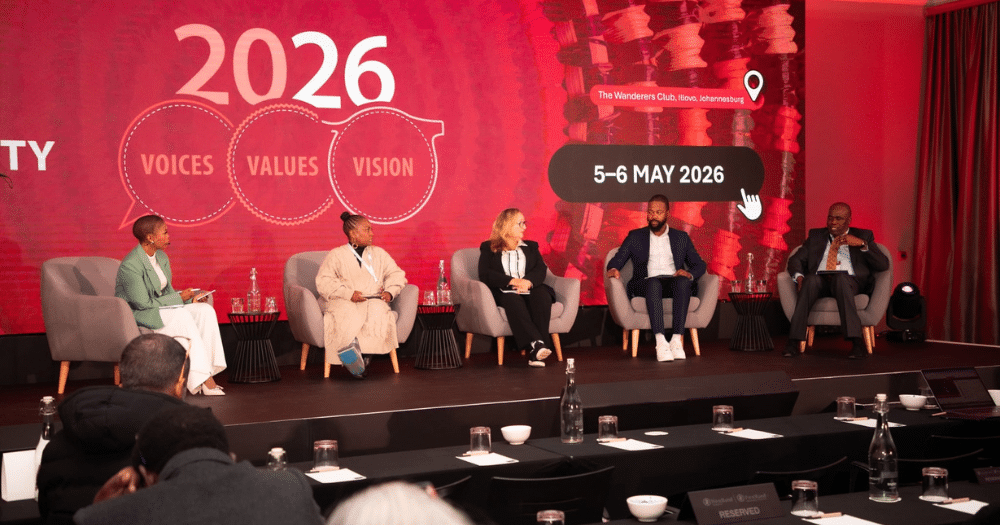
The closing keynote address at the Trialogue Business in Society Conference examined how our funding decisions are determining the country we are becoming.
In his passionate address, Lorenzo Davids – CEO of The Development Impact Fund – argued that, collectively, we are not nearly angry enough about the social ills in our country. He referenced a moment during the conference when a panellist shared she had “registered my business out of anger” after being asked to “wash cars” in her previous position at an air-conditioning company.
“We should be angry with poverty, the government, funders, communities, ourselves – our collective inertia, passivity, lethargy, rigidity, stagnation, and procrastination,” Davids said, adding that children dying in pit latrines and clinics, and failing to get a proper education, is a “cancer” in society.
Funding is world-building
South Africa is one of the most unequal countries in the world, yet our funding proposals seldom reflect this reality. Instead, Davids argued, we design “bracketed interventions” rather than being courageous enough to design expansive solutions capable of shaping the country for the foreseeable future. Too often, the sector is afraid to risk reputation and status to “dream bigger”.
“We have been conditioned to be compliant and subservient, rather than disruptive and brave,” he said. “However, if your board members are not brave enough to face the issues in our country, they are not your board members.”
He went on to describe funding as an act of world-building. “Every cent invested builds a particular version of the world you want. Which version are you building?”
A failure of imagination
Anchoring his argument in South Africa’s Constitution, Davids pointed to its promise of dignity, equality, justice, safety and shared prosperity as the ultimate mandate for development work. Yet despite the scale of effort and investment, he argued that South Africa lacks imagination at a national level.
“We’re doing country duty,” he said, “but what are our great plans?”
Too often, funding is disconnected from any shared vision of the society it is meant to build. “We use data to write funding reports to maintain the system that doesn’t change the data,” Davids said, noting that it does not “rush us through revolution” or compel us to act differently. Language, he argued, reinforces this failure of imagination. Davids called for the word “beneficiaries” to be abandoned altogether.
“Either we are partners – funders, NGOs and citizens – equally engaged in fixing the country, or we are not,” he said. Development, he stressed, is not charity, nor a space for guesswork, but a question of social justice requiring intelligence, innovation and collaboration.
Social justice should drive grantmaking
This is a theme Davids has returned to consistently. At the Trialogue Business in Society Conference in 2023, he urged funders to “stop using the severity of need as the basis for funding”, predicting that social justice would become “the dominant filter for grant making with intelligent donors”.
Three years on, his concern is that proposals have become increasingly technical while losing sight of the underlying problem. “We’ve fallen in love with our own solutions and not with the problem,” he said, quoting Kentse Radebe, deputy CEO of DGMT. The result, Davids warned, is a lack of urgency and understanding that is “scary” given the scale of South Africa’s challenges. “When a funder listens to you, they should feel every emotion you carry deep in your soul.”
The sector, he argued, also thinks too small.
“Funders don’t want to write R5 million proposals over 10 years if they can write a R50 million proposal that can build something that will last forever,” he said. Instead of designing programmes, Davids challenged the sector to design systems – food security rather than food programmes – and to “build bigger words into our solutions”.
Individual success stories may be compelling, but they cannot substitute for collective ambition. “How can we transform entire communities rapidly?” he asked. “Why is there no country plan emerging?”
A lack of collective ambition
This frustration, Davids made clear, is shared by funders themselves. “Funders we consult for and talk with all give us a sense that we can’t keep doing this,” he said. While organisations may produce strong monitoring and evaluation and “brilliant reports”, “the data speaks louder than your programme. It says things aren’t getting better. Funders are worried.”
Yet that concern has not translated into collective ambition. “There’s no bigger plan,” Davids said. “Nothing that says 50 NGOs got together to write a plan for food security.”
Part of the problem, Davids suggested, is that the sector has closed itself off from honest critique and collaboration. “CSI appears to be too closed for open conversation with external stakeholders,” he said. “It should say: help us shape our strategy.” NGOs, too, should be more open to challenge. “Who’s critiqued them?” he asked. At a deeper level, he argued, “voices, values and vision are crying out for a conversation”.
That conversation is especially urgent in a context where Africa is routinely framed as hopeless. “People see us as a hopeless continent,” Davids warned. “So, get together and plan. Put a different dream together for your country – not the subject of irresponsible reporting.” Leadership, he argued, requires time and space for imagination. “As CEOs, you have to make time to dream about what should take place and what keeps you going in that bigger space.”
Facing the chaos head-on
To underline the importance of staying focused on outcomes, Davids shared a personal example from outside the development sector. A long-time commuter, he repeatedly called out the collapse of Cape Town’s rail system, tagging Metrorail, PRASA and then transport minister Fikile Mbalula on social media. After being blocked, he persisted, speaking to local and international media and repeating the same message: the trains had to return to the lines. “Who am I? I’m just a commuter standing on the platform with a phone in my hand trying to be smart,” he said. “But in my heart, I wanted the trains back for everyone.” Eventually, the lines reopened.
Davids closed by urging the sector to rethink its relationship with risk and belief, citing stokvels as evidence that collective self-belief already exists at scale. “That’s a self-help scheme of note,” he said.
He urged delegates to “Face the chaos, frame the chaos, fund the chaos, forge the chaos – then come back and write – not your proposal – your heart.”